
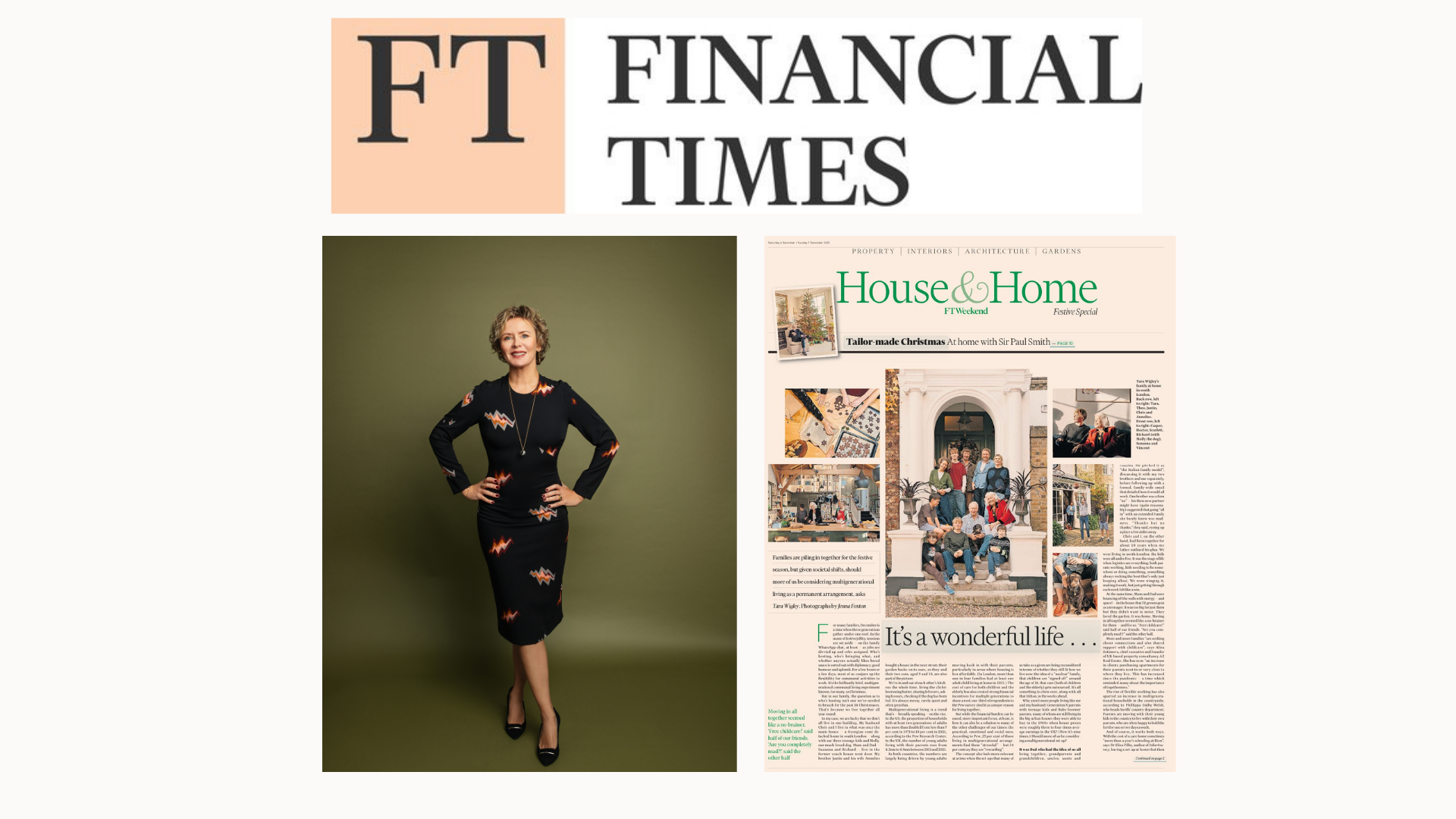
Our founder and CEO, Alisa Zotimova, was invited to comment for The Financial Times regarding the increase in clients purchasing properties for their parents nearby to maintain closer family connections and shared support.
For many families, December is a time when three generations gather under one roof. In the name of festive jollity, tensions are set aside — on the family WhatsApp chat, at least — as jobs are divvied up and roles assigned. Who’s hosting, who’s bringing what, and whether anyone actually likes bread sauce is sorted out with diplomacy, good humour and aplomb. For a few hours or a few days, most of us conjure up the flexibility for communal activities to work. It’s the brilliantly brief, multigenerational communal living experiment known, for many, as Christmas. But in our family, the question as to who’s hosting isn’t one we’ve needed to broach for the past 14 Christmases. That’s because we live together all year round.
In my case, we are lucky that we don’t all live in one building. My husband Chris and I live in what was once the main house — a Georgian semi-detached home in south London — along with our three teenage kids and Molly, our much-loved dog. Mum and Dad — Suzanna and Richard — live in the former coach house next door. My brother Justin and his wife Annelies bought a house in the next street; their garden backs on to ours, so they and their two sons, aged 9 and 10, are also part of the picture.
We’re in and out of each other’s kitchens the whole time, living the cliché: borrowing butter, sharing leftovers, asking favours, checking if the dog has been fed. It’s always messy, rarely quiet and often great fun.
Multigenerational living is a trend that’s — broadly speaking — on the rise. In the US, theproportion of households with at least two generations of adults has more than doubled from lessthan 7 per cent in 1971 to 18 per cent in 2021, according to the Pew Research Center. In the UK, thenumber of young adults living with their parents rose from 4.2mn to 4.9mn between 2011 and 2021.
In both countries, the numbers are largely being driven by young adults moving back in with theirparents, particularly in areas where housing is less affordable. (In London, more than one in fourfamilies had at least one adult child living at home in 2021.) The cost of care for both children andthe elderly has also created strong financial incentives for multiple generations to share a roof;one-third of respondents to the Pew survey cited it as a major reason for living together.
But while the financial burden can be eased, more important for us, at least, is how it can also be asolution to many of the other challenges of our times: the practical, emotional and social ones. According to Pew, 23 per cent of those living in multigenerational arrangements find them“stressful” — but 54 per cent say they are “rewarding”.
The concept also feels more relevant at a time when the set-ups that many of us take as a given arebeing reconsidered in terms of whether they still fit how we live now: the idea of a “nuclear” family,that children are “signed off” around the age of 18, that care (both of children and the elderly) getsoutsourced. It’s all something to chew over, along with all that Stilton, in the weeks ahead.
Why aren’t more people living like me and my husband: Generation X parents with teenage kidsand Baby-boomer parents, many of whom are still living in the big urban houses they were able tobuy in the 1980s when house prices were roughly three to four times average earnings in the UK? (Now it’s nine times.) Should more of us be considering a multigenerational set-up?
It was Dad who had the idea of us all being together, grandparents and grandchildren,uncles, aunts and cousins. He pitched it as “the Italian family model”, discussing it with my twobrothers and me separately, before following up with a formal, family-wide email that detailed howit would all work. One brother was a firm “no” — his then new partner might have (quitereasonably) suggested that going “all in” with an extended family she barely knew was madness.“Thanks but no thanks,” they said, eyeing up a place a few miles away.
Chris and I, on the other hand, had been together forabout 10 years when my father outlined his plan. Wewere living in north London; the kids were all underfive. It was the stage of life when logistics areeverything: both parents working, kids needing to besomewhere or doing something, something alwaysrocking the boat that’s only just keeping afloat. Wewere winging it, making it work, but just gettingthrough each week felt like a win.
At the same time, Mum and Dad were bouncing off the walls with energy — and space! — in thehouse that I’d grown up in as a teenager. It was too big for just them but they didn’t want to move.They loved the garden. It was home.
Moving in all together seemed like a no-brainer for them —and for us. “Free childcare!” said half of our friends. “Are you completely mad?!” said the otherhalf.
More and more families “are seeking closer connections and also shared support with childcare”,
says Alisa Zotimova, chief executive and founder of UK-based property consultancy AZ Real Estate.
She has seen “an increase in clients purchasing apartments for their parents next to or very close towhere they live. This has increased since the pandemic — a time which reminded many about theimportance of togetherness.”
The rise of flexible working has also spurred an increase in multigenerational households in thecountryside, according to Phillippa Dalby-Welsh, who heads Savills’ country department. Parentsare moving with their young kids to the country to live with their own parents, who are often happyto hold the fort for one or two days a week.
And of course, it works both ways. With the cost of a care home sometimes “more than a year’sschooling at Eton”, says Dr Eliza Filby, author of Inheritocracy, having a set-up at home that thenenables care to come in makes a lot of sense. “It’s not just the cost of care but, also, the complexity,”Filby says. And for the generation below me, while every cohort has their challenges, to paraphrase Filby, thetraditional narrative of “work hard, earn money, buy a house, get kids to school, live comfortably”does not apply today. “It’s no longer so much what someone earns or learns which defines theiropportunities, safety net and springboard into adulthood, so much as their access to the Bomad[bank of mum and dad]”. Work, in short, is no longer always the route to wealth that it was. WhenFilby visits companies, she tells them that their employees are “more likely to get on the housingladder by being loyal to their parents than they are being loyal to their boss”.
Read full article here.